Oman Rooftop Tent Road Trip: A First-Hand 4WD Report

Guest report from a nomad rooftop tent rental customer, Oman
This first-hand Oman rooftop tent road trip report is based on a real self-drive journey with one of our 4WD rental vehicles. The route combines mountain roads, desert tracks, remote wells in the Rub al-Khali, the frankincense region of Dhofar, turtle watching at Ras al Jinz and the coastal road back to Muscat.
We completed a rooftop tent road trip through Oman, driving a Nissan Patrol 4WD from Muscat through the Jebel Akhdar mountains to the Rub' al-Khali desert and back. Here is our first-hand account.
What Was the Route for This Oman Rooftop Tent Road Trip?
At the hotel, the Nissan Patrol 4×4 got handed over to us on time. The rooftop tent was brand new, and most of the camping kit was too. After a quick stop at the LULU Supermarket for supplies, we set off straight away.
Our first stop was Nakhl Fort, where we found a quiet spot for the night. The next day's route passed through Snake Gorge and climbed to nearly 2,000 metres via Hat Pass, crossing the Jebel Akhdar range. From there we continued into the Jebel Shams massif, known for its steep rock faces and deep gorges, including Oman's own Grand Canyon.
The route then passed through Nizwa, Oman's ancient capital, with its historic castle complex. From Nizwa, we headed south through the Reg Desert, running the air conditioning against the heat. On the way, a side track led us 40 km to a field of white gypsum rock formations.
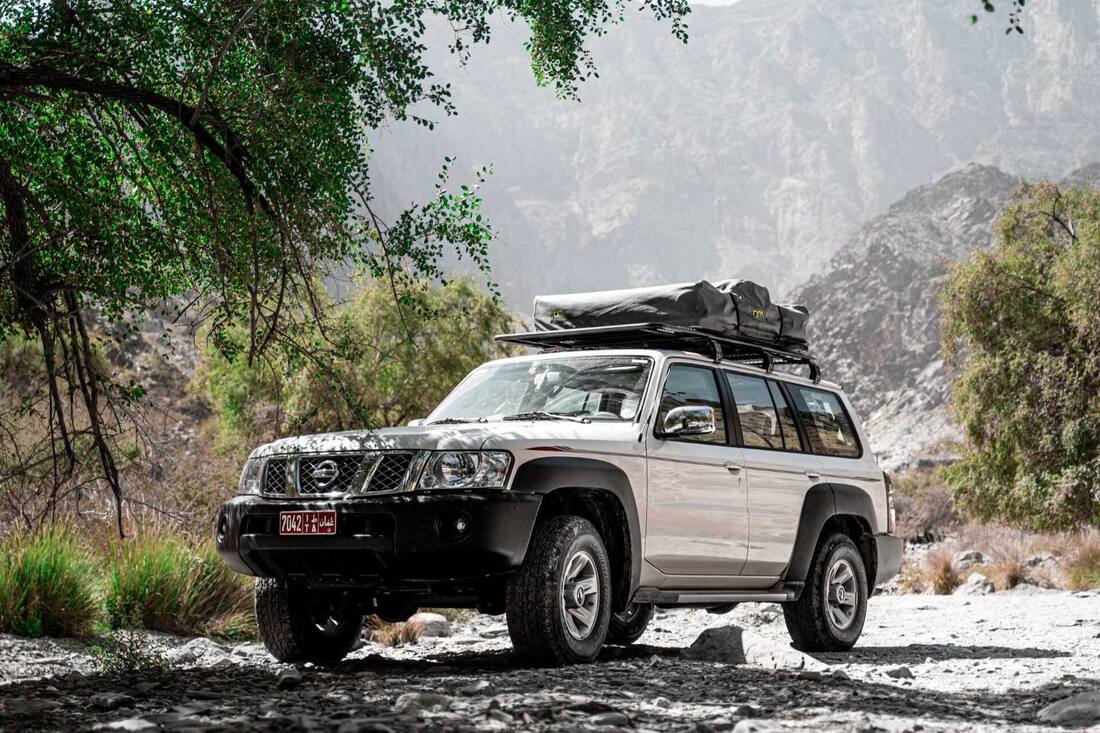
Read our complete 4WD self-drive guide to Oman for route planning and vehicle tips, or find out why Oman is a safe country to visit in 2026.
What Is It Like to Drive into the Rub al-Khali Desert by 4WD?
South of the Reg Desert lies the Rub' al-Khali — the Empty Quarter, one of the largest sand deserts in the world. We visited Ubar, an archaeological site near the Shisr oasis linked to old trade routes across the desert. This is one of the few places where black dromedaries can still be seen.
We continued to a group of remote wells first documented by explorer Wilfred Thesiger in 1945, and spent three days in this quiet, isolated stretch of desert.
What Did the Southern Oman Road Trip Include?
From the desert, the route continued south to reach the frankincense trees that still grow in remote wadis. Frankincense was traded across Arabia for centuries under the name "gold of Arabia." We ended this leg in Salalah, on the Arabian Sea, where we stayed at a hotel and tried food at local restaurants along the coast.
Heading back north along the coast, we stopped at Ras al Jinz Turtle Reserve. That evening, five green turtles came ashore to lay eggs — each around one metre long and weighing 150–250 kg. Their eggs take around 90 days to hatch. Turtles return to the beach where they hatched to lay their own eggs, even after years spent at sea.
Next stop was Sur, once a centre for building traditional dhows. Boat builders constructed these wooden ships using wooden nails instead of metal fasteners. Some retired dhows can still be seen resting on the beaches around Sur.
The return to Muscat followed the recently upgraded motorway. We arrived at the hotel ahead of schedule and returned the vehicle without any issues. 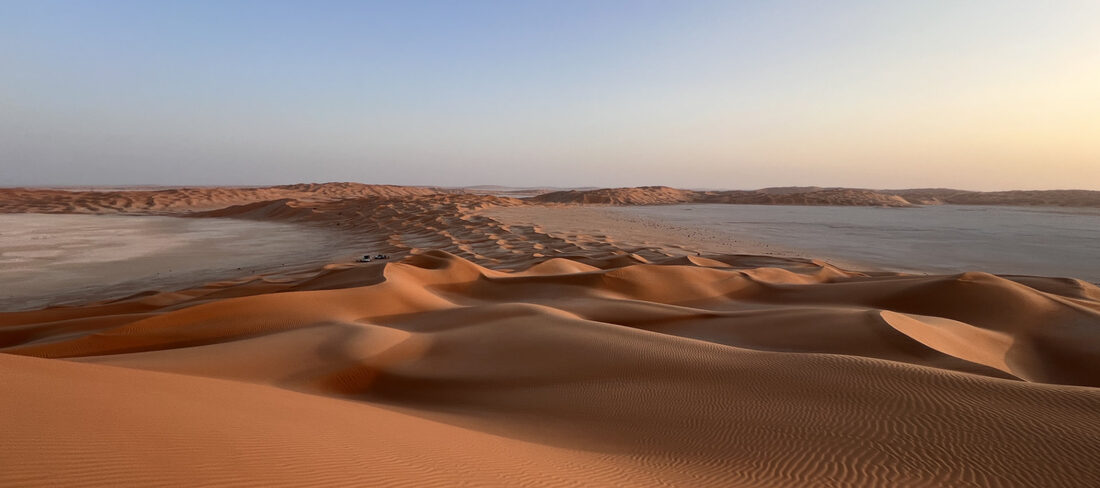
What Equipment Is Essential for a Rub al-Khali 4WD Expedition?
We'd recommend three items for any major desert tour into the Rub' al-Khali: a spare fuel canister, sand plates (HEBE), and a compressor fridge instead of a standard cool box.
Browse our Toyota Prado and Isuzu DMax fleet → Questions about vehicle hire? Contact us directly at info@nomad-reisen.de or by phone on +49-6553-83297-0.
Read the full German-language first-hand report version on blog.nomad-reisen.de