Driving in Oman by Rental Car: Road Rules, Safety Tips and 4WD Advice

Planning a self-drive trip in Oman is one of the best ways to experience the country. With a rental car or 4WD, you can explore mountain roads, wadis, deserts, coastal routes and small villages at your own pace. Oman is generally an excellent country for independent travellers: roads are mostly in good condition, signs are usually in both Arabic and English, fuel is widely available and local people are exceptionally helpful.
Before you start your Oman road trip, however, it is important to understand a few practical rules. What is the speed limit in Oman? Who has right of way in a roundabout? Are there enough petrol stations? What should you do after an accident? And when do you need a 4WD?
This guide answers the most important questions about driving in Oman by rental car, including traffic rules, road safety, petrol stations, animal hazards, dirt roads, 4WD driving and what to do in the event of an accident.
Quick Answers: Driving in Oman
Is Oman good for a self-drive trip?
Yes. Oman is one of the best countries in the Middle East for a self-drive holiday. Roads are generally well maintained, signage is good, fuel is widely available and driving is straightforward outside the larger cities.
Do you drive on the left or right in Oman?
Traffic in Oman drives on the right-hand side of the road.
What are the speed limits in Oman?
As a general rule, the speed limit is 50 km/h in towns, 80 km/h on single-carriageway roads outside built-up areas and 120 km/h on motorways, unless otherwise signposted.
Do I need a 4WD in Oman?
For Muscat, main roads and standard coastal routes, a normal rental car is usually sufficient. For Jebel Akhdar, many mountain tracks, desert roads, wadis and unpaved routes, a 4WD is either required or strongly recommended.
Is driving at night safe in Oman?
Driving at night is possible but should be approached with caution, especially outside towns. Animals, poorly marked breakdown vehicles and unlit roads can create serious hazards.
Vehicles, routes, season, off-road rules and costs — our complete 4WD self-drive guide to Oman covers everything before you even get behind the wheel.
General Traffic Rules in Oman
In Oman, traffic drives on the right. The official speed limit in towns is usually 50 km/h unless otherwise signposted. In some residential or inner-city areas, the limit may be as low as 40 km/h. Outside built-up areas, the speed limit on single-carriageway country roads is usually 80 km/h. On motorways and major dual carriageways, the limit is generally 120 km/h.
Speed cameras are common throughout the country, including on highways and in urban areas. Fines for speeding and other traffic offences can be high, and traffic regulations are generally enforced strictly, particularly in Muscat and on the main roads.
Seat belts have been compulsory in Oman for both front and rear seats since 1996. The fine for not wearing a seat belt is OMR 10.
Driving under the influence of alcohol is strictly prohibited. Oman has a zero-tolerance policy for drink-driving, which means 0.0 per mille.
There are also rules that may surprise visitors. For example, driving a very dirty car can result in a fine. Rental vehicles should therefore be kept reasonably clean, especially before returning them.
Driving in Roundabouts in Oman
Roundabouts are very common in Oman, including large multi-lane roundabouts on major roads. Understanding how they work is essential for safe driving, especially in Muscat and other larger towns.
As a general rule, vehicles already in the roundabout have right of way. Before entering the roundabout, decide which exit you want to take and choose your lane accordingly.
If you want to turn right, use the far-right lane. If you want to go straight ahead, the middle lane is usually the best choice. If you want to turn left or make a U-turn, choose the left-hand lane.
When entering a roundabout, you must watch all vehicles approaching from the left. Vehicles approaching from the left have right of way, not only those in the outer lane. Wait until all relevant lanes are clear before entering the roundabout.
Use your right indicator when you want to leave the roundabout. Use your left indicator if you are staying in the roundabout. Be aware that vehicles in the lane to your left may move towards the right-hand lane at the next exit. Drive defensively and do not assume that all drivers will signal clearly.
Driving at Night in Oman
You should drive with particular caution after dark, especially outside towns and on rural roads. Although Oman’s main roads are generally good, night driving brings additional risks.
Breakdown vehicles may not always be marked with a warning triangle. In some cases, a broken-down vehicle is marked only by a few rows of stones placed on the road behind it. This can be difficult to see at night.
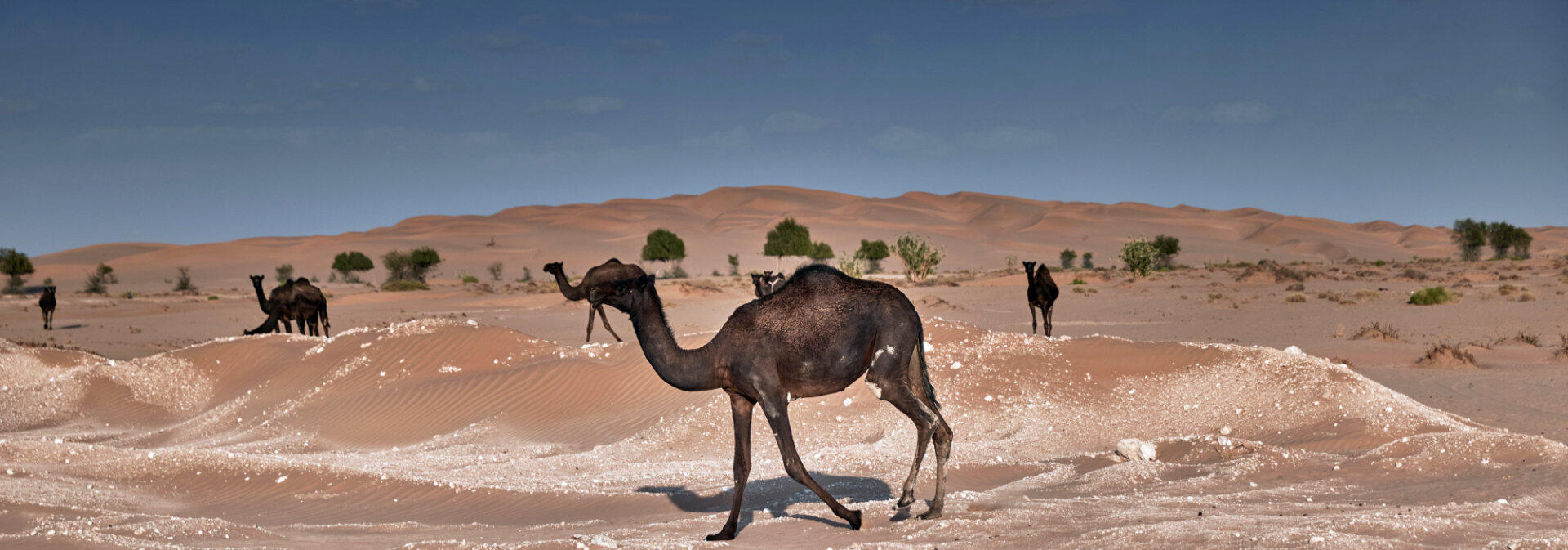
Animals on the road are another serious hazard. Camels, goats, donkeys and cattle may cross roads unexpectedly, especially in Dhofar in southern Oman and in the interior. Whole herds of camels or cattle may appear on or near the road.
If you see a camel, donkey or other animal near the road, reduce your speed immediately and switch on your hazard warning lights. Drive past slowly enough that you could stop at any moment. Camels are fast and can suddenly run onto the carriageway. Accidents involving camels are particularly dangerous because their long legs mean that, upon impact, the body of the animal may hit the windscreen.
Once you have passed the danger spot, warn oncoming vehicles by briefly flashing your headlights. Likewise, if an oncoming vehicle flashes its headlights at you, this may indicate an animal, accident or another hazard ahead.
Petrol Stations and Supplies in Oman
Oman has a dense network of petrol stations along paved roads. The main operators include Shell, Oman Oil and al-Maha. Fuel is comparatively inexpensive by European standards and generally easy to find on standard self-drive routes.
Petrol stations are also found along many dirt roads and in smaller settlements. A typical Omani service station includes toilets, usually clean, and a small shop selling basic food, drinks and everyday supplies. Many petrol stations also have a simple restaurant or café.
Opening hours vary, but many stations are open from around 6 am to 10 pm. In Muscat and along major roads, an increasing number of service stations are open 24 hours a day.
Food supplies are also widely available. Even small villages often have shops selling basic groceries. Fruit, vegetables and dairy products are usually easy to find. Unless you are planning to spend several days in remote mountain areas, the desert or the Empty Quarter, there is no need to stock up on large quantities of food.
For drinking water, most travellers buy bottled water or larger refillable containers. Water canisters can also be filled with fresh water at many petrol stations and at mosques. Every mosque has an area where worshippers perform ablutions before prayer. Non-Muslim travellers can usually access these areas without difficulty, provided they behave respectfully.
For environmental reasons, we recommend reducing the use of small single-use plastic bottles wherever possible. Large refillable water containers, often referred to as gallons, are widely available in Oman and can be exchanged through a simple deposit system. This is usually the more sustainable and practical option for a longer Oman road trip.
What to Do in the Event of an Accident in Oman
If you are involved in an accident in Oman, you must contact the police, even if the damage appears minor. Do not move the vehicle from the scene of the accident unless instructed to do so by the police.
It is essential to obtain a copy of the police report detailing the circumstances of the accident. You will need this report for insurance purposes. In Oman, a vehicle damaged in an accident may only be repaired upon presentation of the relevant police report or accident form.
Continuing your journey in a damaged car is strictly prohibited. If you are travelling with a rental car, call your car hire company immediately. If you booked your trip through a tour operator, contact their local or European emergency number as well.
The emergency number for the Royal Oman Police is 9999.
Traffic Offences and Penalties in Oman
Reckless driving is punished severely in Oman. Wrong-way driving, for example, can result in a fine of 500 OMR and a prison sentence of up to three months. Using a mobile phone while driving or throwing rubbish out of the vehicle can also lead to substantial fines, in some cases up to 300 OMR.
Driving under the influence of alcohol or drugs is punishable by a fine and may also result in a prison sentence. Illegal parking is also fined, with higher penalties for parking at bus or taxi stops.
Speed limits are monitored by numerous fixed and mobile speed cameras. In the case of rental cars, speeding fines are often charged automatically to the rental company’s account. This may happen only after the car has been returned. The rental company will then invoice the renter retrospectively and may charge the credit card provided as security when hiring the vehicle.
If you notice a charge on your credit card statement after returning from Oman, it may be a traffic fine. If in doubt, contact your tour operator or the rental company in Oman.
Driving on Dirt Roads in Oman
Many dirt roads and graded tracks in Oman are in good condition. They are regularly maintained, and you will often find traffic and information signs in both Arabic and English even on unpaved routes.
The paved road network is constantly expanding. As a result, printed maps and even some digital maps may not always reflect the current road situation. Some routes that were once dirt tracks have now been paved, while others may change after rain, flooding or roadworks.
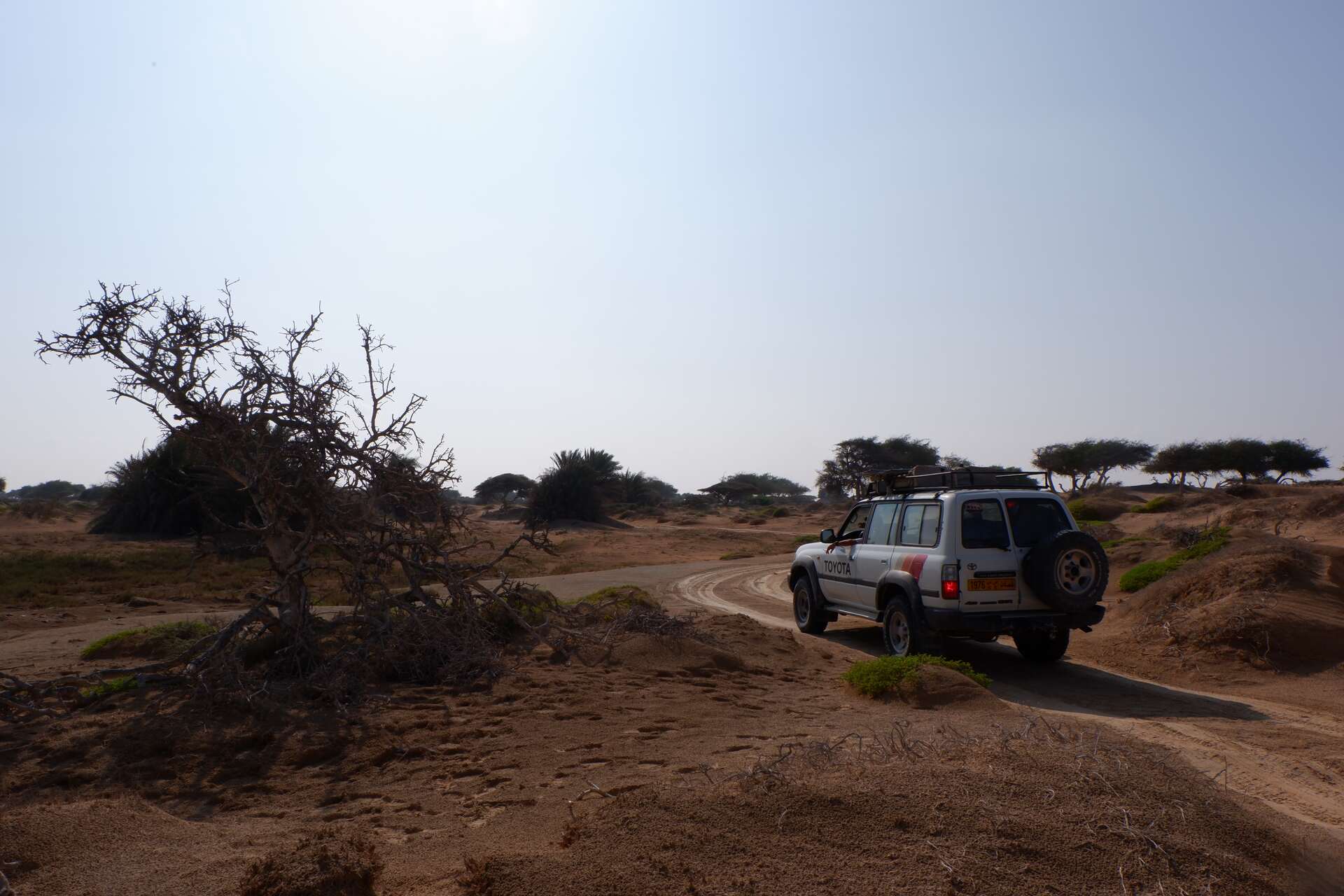
On many private self-drive tours, only a limited number of routes are genuinely off-road today. Exceptions include desert routes in the Wahiba Sands, parts of Jebel Shams and some mountain or wadi routes such as Wadi Bani Awf and Wadi Sahtan. A 4WD is also mandatory for the road to Jebel Akhdar, where checks are carried out at the checkpoint.
Even if a dirt road looks easy at first, conditions can change quickly. Gravel, steep gradients, loose stones, flood damage or soft sand may appear unexpectedly. If you are unsure whether a route is suitable for your vehicle, ask locally before setting off.
Driving a 4WD in Oman
A 4WD opens up many of the most spectacular parts of Oman: mountain plateaus, desert tracks, wadis and remote coastal routes. However, off-road driving in Oman requires preparation and caution.
When driving off-road, you should engage four-wheel drive. For more remote routes, leave details of your planned route, vehicle type and expected arrival time with your hotel reception or, where relevant, the nearest desert police station.
Do not undertake remote off-road routes alone. Ideally, more challenging desert or mountain routes should be driven with at least two vehicles. This is especially important for routes away from the established tracks, deep sand, remote wadis and the Rub al-Khali.
A properly equipped off-road vehicle should carry at least one serviceable spare tyre, preferably two for remote trips, as well as a jack, shovel, tow rope, mats or sand plates, fuel canister, first-aid kit, blankets and sun protection. Sufficient reserves of water and fuel are essential.
For our rooftop tent trips and standard self-drive Oman itineraries, the routes are usually planned so that travellers can manage with the standard equipment provided, without carrying excessive extra supplies. For remote desert or mountain routes, however, additional equipment may be required.
Wadi Driving and Flash Floods
Wadis are one of Oman’s great natural attractions, but they also present one of the country’s most serious driving risks. Flash floods can occur with little warning, especially when rain falls in the mountains upstream.
Before setting off on a wadi route, ask locally whether the track is passable. Wadis must be avoided or left immediately if clouds are low, rain begins to fall or water levels rise. Fatal accidents occur repeatedly because travellers underestimate flash floods.
Never camp in a wadi bed. Even if the weather appears calm where you are, rain in the mountains can send a flood wave through the wadi.
Before driving through a wadi carrying water, check the depth and, if necessary, the current on foot. Be aware that vehicles can get stuck easily in wet gravel or sand.
Along paved roads that cross wadis, there are often water-level posts. If the water level is above the red mark, do not continue driving. Driving through a wadi when the water level is marked as dangerous can result in a substantial traffic fine, and the vehicle may be confiscated.
Driving in Sand and Dunes
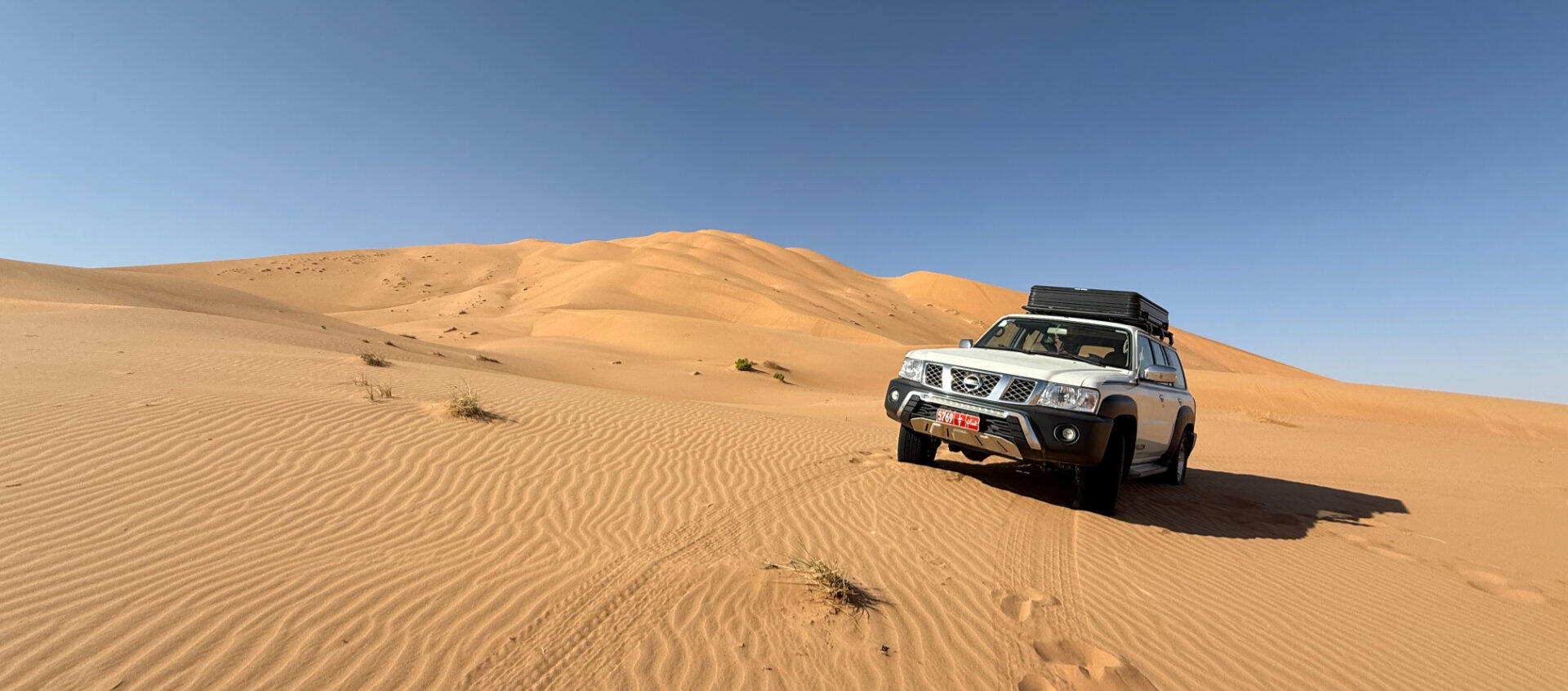
Driving in sand requires a different technique from normal road driving. When driving through dunes, for example with an escort vehicle to a desert camp, low-range gearing and four-wheel drive are essential.
Do not drive for too long in a low gear, as this can cause the engine to overheat. Low gears are suitable for steep sections, difficult passages and setting off on soft ground.
On soft, flat or gently undulating sand, use the highest gear possible without allowing the engine to run at too low a speed. Avoid braking and sudden steering movements as far as possible. Braking can cause the wheels to dig into the sand.
If you notice that the engine is running too low in the rev range, change down early. If you feel the vehicle beginning to get stuck, stop the momentum carefully before the wheels dig in. Do not accelerate hard, as this will only cause the wheels to sink deeper into the sand.
Tyre pressure is one of the most important factors in sand driving. Reducing tyre pressure increases the contact area of the tyre and helps the vehicle float over soft sand. After leaving the sand and returning to firm ground or asphalt, tyres must be reinflated immediately to normal road pressure.
If you have little or no experience of sand driving, do not attempt remote dune routes alone. For a full Wahiba Sands crossing or routes into the Rub al-Khali, a second vehicle or local guide is strongly recommended.
Read our first-hand 4WD report, driving from Jebel Shams to the Rub' al-Khali desert.
Do You Need a 4WD for a Self-Drive Trip in Oman?
Whether you need a 4WD in Oman depends on your route. For Muscat, Nizwa, Sur, major highways and many coastal roads, a standard rental car may be sufficient. For Jebel Akhdar, desert routes, wadis, mountain tracks, beach tracks and remote areas, a 4WD is either required, strongly recommended or necessary for insurance reasons.
Many travellers underestimate the difference between a normal Oman road trip and a 4WD self-drive Oman itinerary. A 4WD gives you more flexibility, better safety margins and access to some of the most impressive landscapes in the country.
For rooftop tent travel in Oman, a 4WD is the natural choice. It allows you to combine camping, mountain routes, desert tracks and remote coastal sections in one itinerary.
Practical Driving Tips for Oman
Plan your driving days realistically. Distances in Oman can look manageable on a map but take longer than expected, especially on mountain roads, dirt tracks or coastal routes with many stops.
Refuel whenever you have the opportunity, especially before entering desert or mountain regions. Keep enough drinking water in the vehicle at all times.
Download offline maps before departure. Google Maps works well for most paved roads, while apps based on OpenStreetMap can be useful for tracks and more remote areas. Do not rely exclusively on mobile reception in wadis, mountains or desert regions.
Avoid driving tired. Long straight roads, heat and monotonous desert sections can be exhausting. Take breaks regularly.
Respect local driving customs, but drive defensively. Do not assume that other drivers will always indicate, keep their lane in roundabouts or maintain distance.
Tailormade tours in Oman
If you are planning a self-drive trip through Oman, nomad will be happy to advise you on route planning, rental cars, 4WD options and rooftop tent travel.
Whether you are interested in a classic Oman road trip, a personalised self-drive Oman itinerary, a 4WD adventure through the mountains and wadis or a rooftop tent journey with wild camping, nomad can help you plan a realistic and safe route.
Browse our Toyota Prado and Isuzu DMax fleet → Or get inspired by a full 1001 Nights self-drive adventure before you plan your route.
Read the full German-language first-hand report version on blog.nomad-reisen.de